
Ignoring prediction markets and employee temptations to bet on them isn’t going to make these new platforms go away. CCI editorial director Jennifer L. Gaskin explores what actions organizations should be considering to make sure they aren’t overlooking their risk for insider trading or reputation damage.
A growing number of state governments and the US Senate in recent months have issued blanket bans on employees using prediction markets. In other organizations, such as OpenAI and United Airlines, policies are more permissive, barring staff members from trading on prediction markets in cases where their insider knowledge would create an unfair advantage. But for most companies, the task of crafting a prediction market policy — and, even trickier, enforcing it — is just beginning, compliance and legal experts told CCI.
Multiple people are facing criminal charges alleging they used insider information related to their jobs to make a buck — or in one case, 1.2 million bucks — playing on prediction markets, the increasingly popular peer-to-peer platforms where users can purchase yes/no contracts based on the outcome of real-world events, including sports, politics, even international warfare.
With the appetite for prediction markets exploding and with enforcement agencies signaling the likelihood of further actions, not doing anything about platforms like Kalshi and Polymarket may not be an option, Steve Silver, a shareholder in Littler’s Portland (Maine) office, told CCI.
For most companies, that means looking at device policies, handbooks, codes of conduct, insider trading policies, employment contracts, nondisclosure agreements and conflict-of-interest policies. But hoping the issue goes away is the worst possible move right now, Silver said.
“Until the federal government acts or the Supreme Court directs the states to act, you’ve got to do the best you can, which is, at its core, deciding a policy,” Silver told CCI. “And that doesn’t mean we need to have a written policy tomorrow. Ignoring it is probably the only way to be completely wrong right now.”
Enforcement actions so far
Prediction markets are formally regulated by the Commodity Futures Trading Commission (CFTC), which classifies the contracts as swaps. More than a dozen states have challenged the CFTC’s authority in the area, and Minnesota recently passed a total ban on the markets.
A pair of cases this year illustrate that enforcers, including the DOJ and US attorney’s offices, are focusing their attention on individuals so far.
In April, the DOJ charged a US Army soldier in connection with a trade worth more than $400,000 just hours before it was revealed that a surprise US raid had captured Venezuelan President Nicolas Maduro, and in May the US attorney for the Southern District of New York announced charges against a Google engineer accused of using his knowledge of search term volume to win contracts totaling more than $1.2 million. If convicted, they each face the potential of multi-year prison sentences.
CFTC Director David I. Miller has indicated more enforcer attention of prediction market activity is likely, saying in March remarks at an NYU Law School event, “Insider trading in the prediction markets — where there is misappropriated information — is precisely the kind of serious violation that we are going after vigorously. We will aggressively detect, investigate and, where appropriate, prosecute insider trading in the prediction markets.”
If only because regulators and enforcers are watching, companies across industries should be paying attention, said Carolyn Pokorny, co-chair of Akerman’s white-collar crime and government investigations practice and a former acting US attorney for the Eastern District of New York.
“There is an enforcement push right now going on in this space, and that should create a sense of urgency in companies.” Pokorny said. “You know, there’s a lot of money involved. The trading on these platforms is absolutely huge. To the extent it gets further and further legitimized, you can expect to see further people trading on these markets.”
In both criminal cases, individuals, not their employers, are the ones facing charges. But while the legal risk doesn’t (yet) extend to the organizations, the reputation risk certainly does, experts agreed.
“Why should Google care that it happened?” Pokorny asked. “I would say the risk is reputational. And it’s an embarrassment for them. I would think for any company, that would be first and foremost.”

Early best practices
Public attention on prediction market risks spiked after the Maduro-related trade in January, and global trading volume on Polymarket rose by more than 35% between January and April 2026, according to Pew data. That suggests the likelihood of employees taking part in prediction market activity is on the rise. Silver and Pokorny pointed to similar starting places for corporate integrity professionals: analyzing current policies.
Silver, an employment law specialist, suggested reviewing confidentiality agreements, handbooks and device policies, while Pokorny also flagged NDAs but called attention to insider trading policies, personal trading rules and policies on conflicts of interest and gambling.
Pokorny noted that even for companies that have insider trading policies that could apply here, it’s worth taking a closer look since those policies almost certainly predate prediction markets.
“I think a lot of the policies are written around securities and don’t mention these kinds of trades. They were written at a time when prediction markets [weren’t] even contemplated,” Pokorny said. In other words, policy modernization may be the best option for some companies.
Others, Silver suggested, could consider brand-new rules written uniquely for prediction markets, as well as potentially expanding the aperture of existing policies.
“What are your existing policies or your agreements and who do they cover?” Silver said. “Because a lot of times those agreements, you’re giving that to high-level executives, maybe some engineers. Maybe that needs to be broader. Maybe you do need, in addition to the handbook, maybe it’s a standalone policy.”
Notably, both of the men charged this year in connection with prediction markets trades are also accused of violating a variety of agreements to safeguard confidential information. As an exchange-listed company, Google’s parent, Alphabet, has an insider trading policy, though its public-facing code of conduct, which references its insider trading policy, has not been updated since 2024. Meanwhile, a draft defense authorization bill released in June includes an explicit prohibition on service members and other Defense Department employees from using nonpublic information on prediction markets.
Insider trading policies tend to reference material nonpublic information (MNPI), which carries a specific legal meaning: information significant enough to affect a company’s stock price that is not available to the public. But prediction markets are much broader, and information that can be abused in the context of prediction markets might not meet the definition of MNPI for securities law purposes. For example, a contract on whether certain words or phrases would appear in an upcoming episode of “Love Island USA” had just under $1,000 in trading volume on prediction market Kalshi as of this writing in June 2026. Since the show is not live, any number of individuals would already know the answer to those yes/no questions, but their knowledge would have no effect on the stock price of Comcast, the parent company of NBCUniversal/Peacock.
So simply expanding insider trading policies isn’t a cure-all, particularly considering not every company with prediction market risk even has an insider trading policy. Making sure employees know they can’t misuse what they learn on the job to make a quick buck is the point, Silver said.
“Probably the number one common factor is we want to make clear that you should not be trading based on our information,” Silver said. “And that is whether it’s considered a trade secret or it’s just nonpublic information — information that you only know because of your job. We don’t want you trading on that, and that’s really as close to ‘best’ as you can do at this point.”
Compliance executive Mary Shirley suggested that if a new policy is required, companies should consider banning employees from any trades involving the company. Short of that, Shirley suggested that communication with employees about what is permitted — new policy or not — is critical. That could be a tweak to the code of conduct, a topical email blast tied to a news event or working a prediction market scenario into annual training.
Congratulations, you have a policy: Now what?
Of course, writing a policy is just the first step, and depending on the company’s existing culture, it might be the easiest. Next comes training, enforcement and monitoring, the last of which is perhaps the biggest challenge of all, experts told CCI.
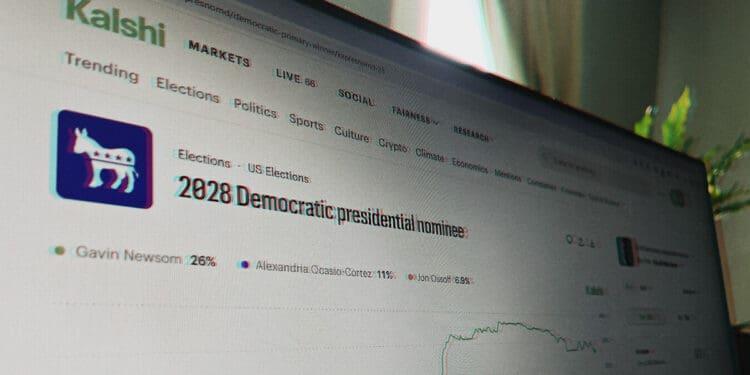
Kalshi, the Polymarket rival, has begun collecting information about traders’ employers, and it does not permit anonymous trading, as Polymarket does. Those two factors mean that certain companies may be able to monitor what their employees are doing on Kalshi.
Some financial services firms, for example, have begun using an integration between Kalshi and StarCompliance, a regtech platform in the financial sector, allowing companies to monitor employees’ Kalshi trades.
Kelvin Dickenson, chief product officer at StarCompliance, was upfront about that scope. All of StarCompliance’s clients are financial services firms, he told CCI — “that’s really the lens” the tool was built through, meaning it doesn’t address monitoring outside of the regulated finance sector. But through that lens, too, there are limitations; one is that companies must rely on their employees to disclose that they have a Kalshi account.
And currently, monitoring is all they can do, though that could change. Future updates may include pre-clearance, or requiring approval before a trade, standard practice for securities at many financial firms, Dickenson said, but prediction markets may move too fast for pre-clearance to be useful.
“[Companies] don’t want to create a very frictionful experience for their employees, because people who are active in prediction markets today work at a very quick speed,” Dickenson said. “They’re going to see a stake, they’re going to say, ‘Hey, I like those odds,’ and they’re going to go for it. What they don’t want to do is spend time putting in a pre-clearance, getting the decision back and then by the time that’s happened, the odds have changed and they’re no longer interested in it, or the market’s just not available anymore.”
That doesn’t mean that companies not monitoring what employees are doing on the platforms are taking no actions at all, Shirley said, pointing out that there are plenty of risk areas around which companies aren’t monitoring. Organizations should, for example, use the tools they already have to see how well trainings are landing.
“For review and monitoring, I’d use my compliance week as a pulse check on colleagues — a quiz-type question around prediction markets to see if there’s knowledge happening there, to check if the communications and training are being absorbed and applied,” Shirley said.
Regardless of whether they are doing formal monitoring or even writing a new policy, talking openly about the issue gives employees a place to go for questions, Shirley and Silver agreed.
“I still believe the vast majority of employees are trying to do the right thing,” Silver said. “And they may have legitimate questions, like, is this OK? And so providing them a resource is a good idea.”

 Jennifer L. Gaskin is editorial director of Corporate Compliance Insights. A newsroom-forged journalist, she began her career in community newspapers. Her first assignment was covering a county council meeting where the main agenda item was whether the clerk's office needed a new printer (it did). Starting with her early days at small local papers, Jennifer has worked as a reporter, photographer, copy editor, page designer, manager and more. She joined the staff of Corporate Compliance Insights in 2021 and also hosts the CCI-produced podcast "Queering Compliance."