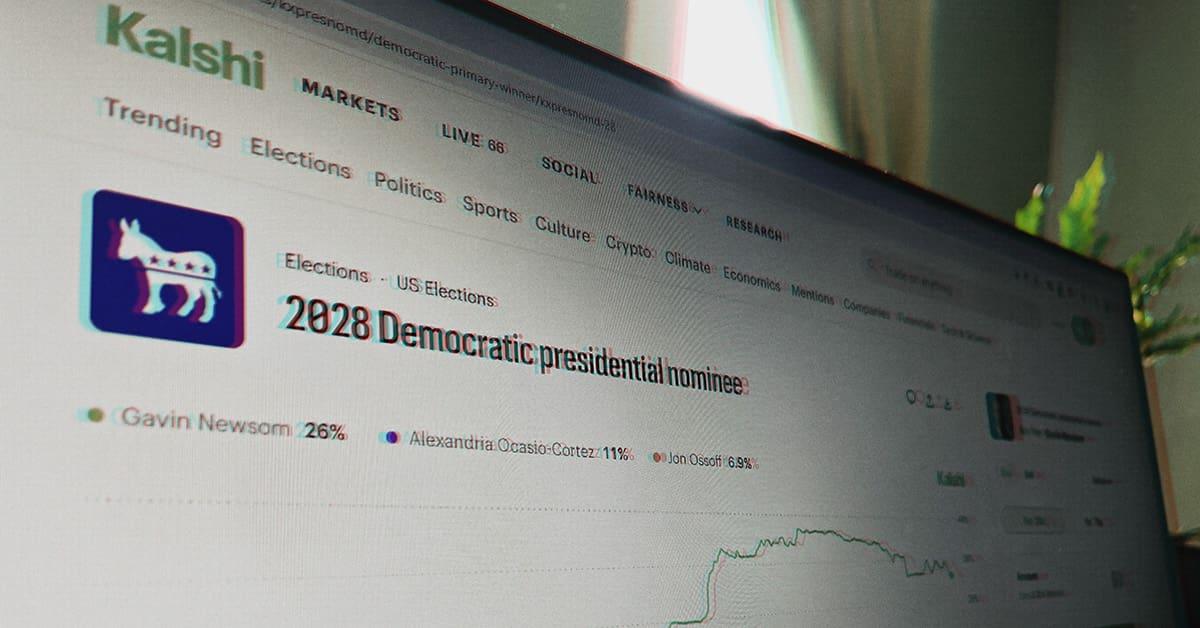
Corporate leaders can’t afford to wait for the regulatory dust to settle around apps like Kalshi and Polymarket, experts told CCI’s Jennifer L. Gaskin. Not only do they risk insiders potentially using their knowledge to make a quick buck on the side, but they may be ignoring ADA-related exposure from employees with gambling problems.
Prediction market platforms Polymarket and Kalshi seem to be racing toward arguments before the Supreme Court to decide who gets to regulate them: states or the federal government. Meanwhile, the platforms’ audience keeps growing and wagering on all manner of things, from who will win the 2026 FIFA World Cup men’s soccer tournament to whether the US government will confirm the existence of extraterrestrials before 2027.
And all the while, even for companies well outside of those traditionally in play for insider trading or market manipulation, risk is expanding. One need look no further than internet personality MrBeast, whose company recently fired a video producer who had made prediction market purchases tied to knowledge of the YouTube star’s upcoming posts, to see how far down the org chart prediction markets are pushing insider trading-type risk.
David I. Miller, director of the Commodity Futures Trading Commission (CFTC), which formally has regulatory authority over prediction markets, has signaled an aggressive stance against insider trading on the apps. However, a variety of state authorities have asserted that they should be the ones to regulate prediction markets because of their resemblance to sports betting. A Supreme Court showdown is likely, said Stephen Piepgrass, a partner in the Richmond, Va., office of Troutman Pepper Locke.
“There are just too many aspects of these cases that make them a quintessential case for the justices to decide: federalism versus state sovereignty, a circuit split, a new business model that doesn’t fit neatly into a current regulatory structure and of course, a great deal of public interest in the outcome.”
In the meantime, corporate leaders and compliance teams have their work cut out for them. Getting their arms around the scope of risk is a challenge for many organizations, whether because they are not aware of it in the first place or because they aren’t sure what they can do about it, legal observers told CCI.
“What I get are questions of, ‘Should we be doing something?’” Steve Silver, a shareholder in Littler’s Portland (Maine) office, told CCI. “Well, the answer is yes, but it also means you’re already behind.”
What can companies do?
The surging popularity of prediction markets (Kalshi’s user base has risen from about 600,000 to more than 5 million since 2025), combined with their unsettled regulatory situation, creates dual pressure on corporate leaders where companies need to monitor their employees’ legal use of the platforms and put in place new guardrails to prevent use that’s unethical or even illegal.
According to experts who spoke with CCI, that means looking at technology use policies, non-disclosure agreements, employment contracts, handbooks and codes of conduct. It also means asking whether the technology controls already in place to restrict access to gambling sites extend to prediction market platforms, which, as regulated derivatives exchanges, may not be captured by existing filtering software.
It could also mean taking a closer look at vendors or even employees’ family members, as well as reexamining what companies think of as the types of information for which they need to control access. Perhaps the old definitions of material non-public information need a refresh.
“All companies, particularly publicly traded companies, need to be developing policies to handle this, both in terms of their employees, their vendors, their contractors, even family members of employees,” Silver said. “It’s hard to police what happens once the information flows to a third party.”
As ever, such determinations need to be done by each individual organization. Some companies, Silver said, may be interested in courting the types of public awareness prediction markets offer and could take the position that all press is good press. Others may wish to assign employees to monitor the markets, not just for how their brands are mentioned but for signs of market manipulation.
Regardless of the specifics, companies must have policies in place if they want to avoid regulatory scrutiny, Piepgrass said.
“Now that the CFTC has clearly stated it believes insider trading rules apply to prediction market trades, [the] commission will expect companies to have updated policies in place,” Piepgrass said. “And if they don’t, we know that regulators often use enforcement actions and penalties to send a message to businesses about the importance of compliance.”

Broadening the risk lens
The democratized nature of prediction markets is forcing companies to rethink not just who has access to sensitive information but what even counts as sensitive information in the first place. Silver gave the example of a food company planning to launch a new flavor. The development and launch of the new flavor is a process that would be known by dozens of people in the company, from executive leadership to social media account managers. In the prediction market era, every one of those people could potentially make money off what they know.
“[T]hose are people that have probably traditionally never been bound by confidentiality or protected information agreements,” Silver said. “So it’s just a much broader universe that companies need to be thinking about.”
But this new risk vector is not discriminatory by industry, Silver warned, particularly for publicly traded companies. Earnings calls, for example, should make public companies take another look at what they consider material non-public information.
“What’s going to be said on [earnings calls]? That’s information that becomes public, right?” Silver said, “And it’s probably edited and workshopped for a long time leading up to it. Is that really the protected information? I don’t know that any existing policies would cover that.”
Policy questions vs. human ones
Outside of the risk of not having policies covering employees inappropriately using internal information to move prediction markets, Silver warned that the growing popularity of apps like Polymarket and Kalshi could generate risk vis-a-vis problem gambling.
Both Polymarket and Kalshi use the nomenclature of “event contract” to describe the activity people engage in on their platforms and have rejected assertions that they are gambling apps. Semantics aside, as we reported earlier this year, the lines are blurry to say the least. Through these apps, for individuals susceptible to the lure of gambling and who think they can make a quick buck, the world becomes one big casino.
The human toll is already playing out. Indiana teenager Nevin Burmeister told Fortune that he lost more than $2,000 in six months on Kalshi bets. Burmeister signed up for the app just after his 18th birthday in a state where, while some gambling is legal, it’s limited to those 21 and older. But apps like Polymarket and Kalshi are open to all adults in the markets where they are permitted to operate. Even those younger than 18 are at risk. Silver, who is also a member of Maine’s state gaming commission, said the board recently had to add an under-18 category to its monthly reports covering calls to the state’s gambling helpline.
A recent survey by the National Council on Problem Gambling found that among those 21 to 44 years old, one-third had placed a sports bet before the age of 21; for those 55 and older, that figure was just 11%.
For Americans of all ages, gambling-esque behavior is becoming increasingly normalized. Sports betting apps are advertised during sporting events, sports news and pregame shows. Video games, too, have expanded exposure to similar activities through things like loot crates.
Reputation risk and insider trading aside, employers also need to be mindful of the Americans with Disabilities Act (ADA), Silver said. That’s because, though the law does not provide protections for those with gambling addiction in the way it might for other addictions, Silver said, people with gambling addictions often also have other issues that may qualify them for accommodation under the ADA.
“Gambling addiction can be linked to a covered mental illness or a covered other addiction, [such as] substance abuse or alcohol,” Silver said. “And so if somebody needs, let’s say, a shortened work period so that they can attend therapy or a meeting, or they need time off to go into inpatient rehab, all of that could be covered, even though by the letter of the ADA [gambling addiction is] not in there.”

 Jennifer L. Gaskin is editorial director of Corporate Compliance Insights. A newsroom-forged journalist, she began her career in community newspapers. Her first assignment was covering a county council meeting where the main agenda item was whether the clerk's office needed a new printer (it did). Starting with her early days at small local papers, Jennifer has worked as a reporter, photographer, copy editor, page designer, manager and more. She joined the staff of Corporate Compliance Insights in 2021 and also hosts the CCI-produced podcast "Queering Compliance."