No Result
View All Result
SUBSCRIBE | NO FEES, NO PAYWALLS
MANAGE MY SUBSCRIPTION
NEWSLETTER
Corporate Compliance Insights
  • About
    • About CCI
    • Writing for CCI
    • NEW: CCI Press – Book Publishing
    • Advertise With Us
  • Explore Topics
    • See All Articles
    • Compliance
    • Ethics
    • Risk
    • Artificial Intelligence (AI)
    • FCPA
    • Governance
    • Fraud
    • Internal Audit
    • HR Compliance
    • Cybersecurity
    • Data Privacy
    • Financial Services
    • Well-Being at Work
    • Leadership and Career
    • Opinion
  • Vendor News
  • Downloads
    • Download Whitepapers & Reports
    • Download eBooks
  • Books
    • CCI Press
    • New: Bribery Beyond Borders: The Story of the Foreign Corrupt Practices Act by Severin Wirz
    • CCI Press & Compliance Bookshelf
    • The Seven Elements Book Club
  • Podcasts
    • Great Women in Compliance
    • Unless: The Podcast (Hemma Lomax)
  • Research
  • Webinars
  • Events
  • Subscribe
Jump to a Section
  • At the Office
    • Ethics
    • HR Compliance
    • Leadership & Career
    • Well-Being at Work
  • Compliance & Risk
    • Compliance
    • FCPA
    • Fraud
    • Risk
  • Finserv & Audit
    • Financial Services
    • Internal Audit
  • Governance
    • ESG
    • Getting Governance Right
  • Infosec
    • Cybersecurity
    • Data Privacy
  • Opinion
    • Adam Balfour
    • Jim DeLoach
    • Mary Shirley
    • Yan Tougas
No Result
View All Result
Corporate Compliance Insights
Home Financial Services

When a Cartel Head Falls, the Money Keeps Moving

Shell companies, real estate purchases and structured trade transactions continue to function even when cartel is leader-less

by Naomi Grossman
February 26, 2026
in Financial Services, Risk
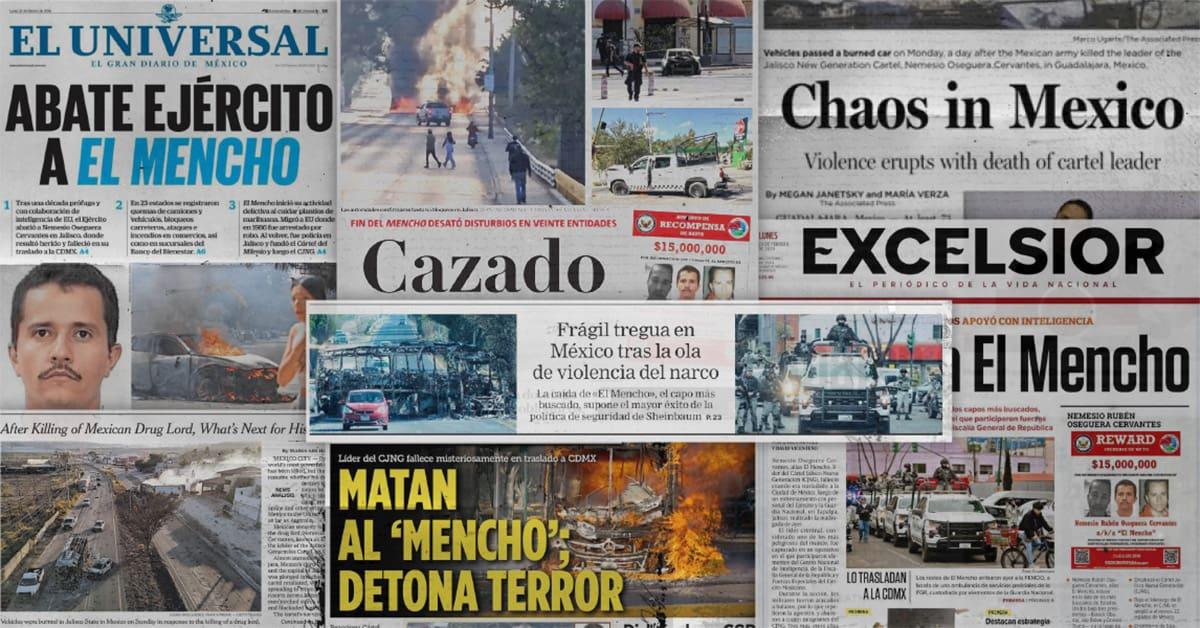
el mencho headline graphic

When Mexican security forces killed a drug kingpin, the nationwide aftermath was immediate and violent. But for compliance professionals around the world, the bigger question is what happens to the billions in illicit funds that CJNG generated, moved and concealed under El Mencho’s leadership. VinciWorks compliance manager Naomi Grossman examines why the cartel’s money-laundering infrastructure doesn’t just disappear when the leader is eliminated and looks at what compliance teams should do now as the cartel’s financial network restructures. 

When Mexican security forces killed Nemesio “El Mencho” Oseguera Cervantes on Feb. 22, in Tapalpa, Jalisco, the nationwide aftermath was immediate and violent, and when the dust settled, dozens of people, along with the drug kingpin, were dead. As the longtime head of the Cártel de Jalisco Nueva Generación (CJNG), Oseguera had built one of the most aggressive and globally connected trafficking networks in the Americas. 

Within hours of his death, armed groups erected roadblocks, set vehicles and commercial properties ablaze and paralyzed transport in multiple states across Mexico. Banks were torched in Jalisco. Flights were disrupted. Schools closed. Hotels were told to keep guests inside.

The global coverage was dramatic to say the least. 

But for compliance professionals, there is another aspect to this event: what happens to the billions in illicit funds that the cartel generated, moved and concealed under El Mencho?

What CJNG built and how it moved money

Under Oseguera’s leadership, CJNG evolved from a regional criminal group into a diversified enterprise generating billions in revenue from cocaine, methamphetamine and fentanyl trafficking into the US. It expanded into fuel theft, migrant smuggling and financial fraud. It embedded itself across over 20 Mexican states and forged links deep into supply and transit routes in Colombia and Ecuador. That kind of scale requires a sophisticated money-laundering infrastructure.

How do cartels of this size recycle their cash? They create shell companies. They acquire real estate through layered corporate vehicles. They disguise cash movement through structured trade transactions. Their funds will cross borders in ways designed to appear commercially routine. Lawyers, accountants and even company formation agents could unwittingly (or wittingly) become involved at different points in the process.

That infrastructure does not disappear when the cartel head is eliminated. It continues to function and could even accelerate illegal financial activity.

mexico landscape viewer
Featured

A Year After Designation of Cartels as Terrorists, What Is the Risk Landscape for Multinationals Operating in Mexico?

by Robert Johnston, Brian Mich and Ulla Pentinpuro
February 18, 2026

Read moreDetails

Financial risk intensifies

One thing that happens is that senior surviving figures in the cartel want to secure their personal funds before assets might be frozen. Also, factions start competing for control and attempt to consolidate revenue streams. Splinter groups may divert funds into new ventures. Some analysts think that CJNG faces a contested succession, mostly because so many of the family members are in jail and a clear heir does not appear to have been designated. This could further intensify the jockeying for financial position.

Long-dormant entities may suddenly become active. Ownership structures may be rearranged. The funds will still need to move. The question for compliance teams is whether their controls are positioned to detect the change in pattern.

The sanctions dimension financial institutions cannot ignore

In 2025, the US government designated CJNG, and more than a half-dozen others, as a foreign terrorist organization (FTO). That classification substantially increases the legal exposure for any institution that might, even inadvertently, facilitate the movement of funds connected to the cartel or its associates.

The material support prohibition that accompanies an FTO designation is broad. It extends beyond direct financial transfers to services, personnel and resources that benefit the organization. Compliance teams should factor that into their approach when reviewing Mexico-linked counterparties, particularly where beneficial ownership structures are complex or opaque.

US-Mexico security cooperation has grown, and enforcement attention will not diminish in the aftermath of El Mencho’s death. Prosecutors and regulators will be closely monitoring what happens to CJNG’s financial networks. Institutions that can demonstrate robust due diligence processes will be in a stronger position if questions arise.

The specific risks for financial institutions

Financial institutions handling cross-border transactions with any Mexican or Latin American nexus should be reviewing their risk frameworks. The concern is not primarily about obviously criminal transactions but rather structures designed to look ordinary.

Compliance teams should be alert to unusual patterns in wire transfers involving Mexican entities for which establishing the ultimate beneficial owner is difficult. Increased activity through correspondent banking relationships that touch Central American or Caribbean jurisdictions warrants scrutiny. Real estate transactions structured through multiple corporate layers, particularly all-cash purchases, require enhanced review. Trade finance professionals should examine invoice integrity carefully and flag shipment patterns that do not align with the stated commercial relationship.

There is also a geographic dimension. Funds may be shifted toward jurisdictions where enforcement capacity is perceived as lower or where political relationships with US authorities are less developed. Risk ratings for certain jurisdictions should be reviewed for currency.

Beneficial ownership data sits at the center of all of this. Much of what makes cartel-connected financial flows difficult to detect is the deliberate obscuring of who ultimately controls the assets. Surface-level customer due diligence is insufficient. Institutions need to understand the full ownership chain and have processes in place to detect when that chain is being rearranged.

What should compliance teams do now?

The risk here is real. And, as compliance leaders are well aware, all of this activity can appear, at least on the surface, entirely legitimate.

Risk assessments connected to Mexico and CJNG-adjacent jurisdictions should be reviewed and updated. Beneficial ownership information should be verified, not simply held on file. Accounts or entities flagged for high-risk geographic exposure should be subject to enhanced due diligence as standard.

Internal escalation processes matter, too. Frontline staff need to understand what suspicious activity looks like in this context and be confident that reporting it internally will be met with seriousness. Board-level briefings on geographic and sanctions exposure are worth scheduling for institutions with meaningful Latin American business.

It is tempting to view this recent spate of cartel violence as a security issue that’s not relevant to your company located in another country. But the financial network is transnational. CJNG’s network touched supply chains, markets and financial systems everywhere from South America to North America and beyond. Its destabilization won’t occur in isolation. It will echo through the many channels the cartel used to move its money.

Ultimately, El Mencho’s death could weaken CJNG. Or it may trigger additional targeted operations by Mexican authorities. But criminal organizations don’t just vanish after a single operation that eliminates one individual. Likely, the cartel will try to adapt and restructure.

While the public watches the cars burn, compliance teams should be watching the money flow.

Tags: AMLSupply Chain
Previous Post

Terminus Capital Partners Takes Majority Stake in Trade Surveillance Provider Eventus

Next Post

2025 Analysis: Securities Class Actions

Naomi Grossman

Naomi Grossman

Naomi Grossman is a compliance manager at VinciWorks, a provider of online compliance training and risk management software.

Related Posts

barbed wire hundred dollar bill sanctions concept

The State of OFAC Sanctions Enforcement in 2025-26

by Jessica Carey, Roberto Gonzalez, Nicole Succar and Sam Kleiner
March 16, 2026

OFAC issued 14 enforcement actions in 2025, but the more important signal may be who got dinged

crypto tokens on background

Banks Are Joining the Race to Issue Stablecoins; Can Their Compliance Teams Keep Up With the Risks?

by David Soiles and Manish Chopra
March 13, 2026

Controls and infrastructure banks have built over decades were designed for a different speed of money

iran supreme leader protest

US-Iran Conflict Highlights Cascading Global Risks

by Nick Henderson-Mayo
March 5, 2026

Crypto outflows, art market evasion routes and a Strait of Hormuz chokepoint — the sanctions and supply chain exposure from...

eu tiny flag

4 Priorities for Compliance Officers Navigating Europe’s Transformed Financial Landscape

by Rūta Mrazauskaite
March 3, 2026

Digitalization and globalization have created financial institutions of every size and form, requiring compliance functions that scale from one-person teams...

Next Post
Cornerstone Securities Class Action Settlements 2025 Whitepaper

2025 Analysis: Securities Class Actions

No Result
View All Result

Privacy Policy | AI Policy

Founded in 2010, CCI is the web’s premier global independent news source for compliance, ethics, risk and information security. 

Got a news tip? Get in touch. Want a weekly round-up in your inbox? Sign up for free. No subscription fees, no paywalls. 

Follow Us

Browse Topics:

  • CCI Press
  • Compliance
  • Compliance Podcasts
  • Cybersecurity
  • Data Privacy
  • eBooks Published by CCI
  • Ethics
  • FCPA
  • Featured
  • Financial Services
  • Fraud
  • Governance
  • GRC Vendor News
  • HR Compliance
  • Internal Audit
  • Leadership and Career
  • On Demand Webinars
  • Opinion
  • Research
  • Resource Library
  • Risk
  • Uncategorized
  • Videos
  • Webinars
  • Well-Being
  • Whitepapers

© 2026 Corporate Compliance Insights

Welcome to CCI. This site uses cookies. Please click OK to accept. Privacy Policy
Cookie settingsACCEPT
Manage consent

Privacy Overview

This website uses cookies to improve your experience while you navigate through the website. Out of these, the cookies that are categorized as necessary are stored on your browser as they are essential for the working of basic functionalities of the website. We also use third-party cookies that help us analyze and understand how you use this website. These cookies will be stored in your browser only with your consent. You also have the option to opt-out of these cookies. But opting out of some of these cookies may affect your browsing experience.
Necessary
Always Enabled
Necessary cookies are absolutely essential for the website to function properly. These cookies ensure basic functionalities and security features of the website, anonymously.
CookieDurationDescription
cookielawinfo-checbox-analytics11 monthsThis cookie is set by GDPR Cookie Consent plugin. The cookie is used to store the user consent for the cookies in the category "Analytics".
cookielawinfo-checbox-functional11 monthsThe cookie is set by GDPR cookie consent to record the user consent for the cookies in the category "Functional".
cookielawinfo-checbox-others11 monthsThis cookie is set by GDPR Cookie Consent plugin. The cookie is used to store the user consent for the cookies in the category "Other.
cookielawinfo-checkbox-necessary11 monthsThis cookie is set by GDPR Cookie Consent plugin. The cookies is used to store the user consent for the cookies in the category "Necessary".
cookielawinfo-checkbox-performance11 monthsThis cookie is set by GDPR Cookie Consent plugin. The cookie is used to store the user consent for the cookies in the category "Performance".
viewed_cookie_policy11 monthsThe cookie is set by the GDPR Cookie Consent plugin and is used to store whether or not user has consented to the use of cookies. It does not store any personal data.
Functional
Functional cookies help to perform certain functionalities like sharing the content of the website on social media platforms, collect feedbacks, and other third-party features.
Performance
Performance cookies are used to understand and analyze the key performance indexes of the website which helps in delivering a better user experience for the visitors.
Analytics
Analytical cookies are used to understand how visitors interact with the website. These cookies help provide information on metrics the number of visitors, bounce rate, traffic source, etc.
Advertisement
Advertisement cookies are used to provide visitors with relevant ads and marketing campaigns. These cookies track visitors across websites and collect information to provide customized ads.
Others
Other uncategorized cookies are those that are being analyzed and have not been classified into a category as yet.
SAVE & ACCEPT
No Result
View All Result
  • About
    • About CCI
    • Writing for CCI
    • NEW: CCI Press – Book Publishing
    • Advertise With Us
  • Explore Topics
    • See All Articles
    • Compliance
    • Ethics
    • Risk
    • Artificial Intelligence (AI)
    • FCPA
    • Governance
    • Fraud
    • Internal Audit
    • HR Compliance
    • Cybersecurity
    • Data Privacy
    • Financial Services
    • Well-Being at Work
    • Leadership and Career
    • Opinion
  • Vendor News
  • Downloads
    • Download Whitepapers & Reports
    • Download eBooks
  • Books
    • CCI Press
    • New: Bribery Beyond Borders: The Story of the Foreign Corrupt Practices Act by Severin Wirz
    • CCI Press & Compliance Bookshelf
    • The Seven Elements Book Club
  • Podcasts
    • Great Women in Compliance
    • Unless: The Podcast (Hemma Lomax)
  • Research
  • Webinars
  • Events
  • Subscribe

© 2026 Corporate Compliance Insights