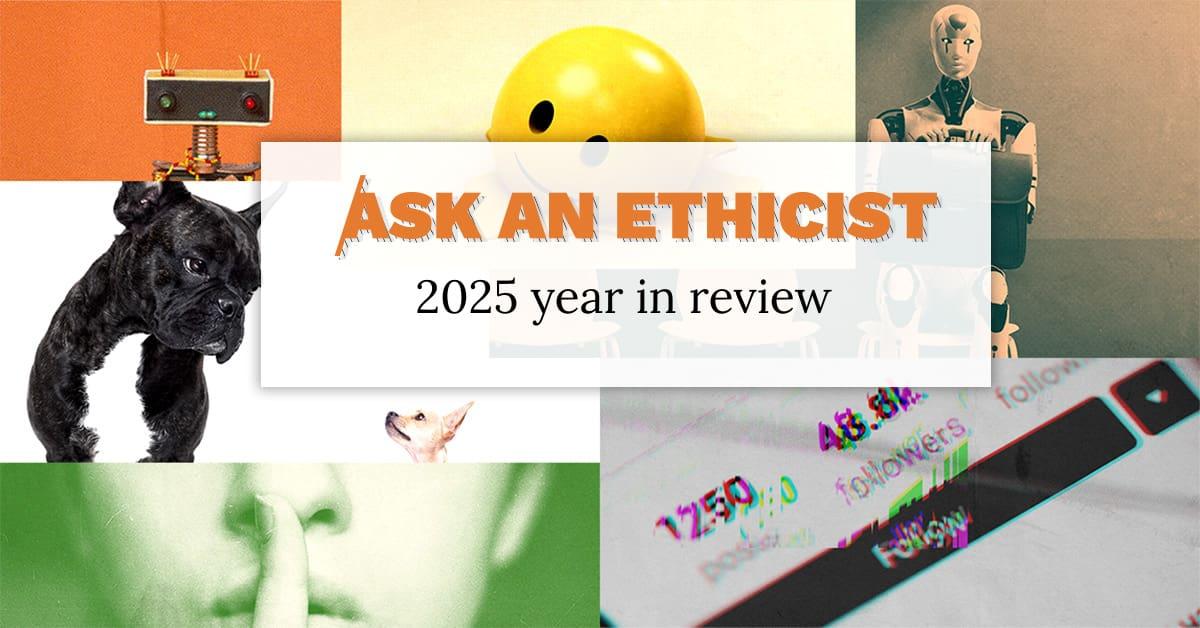
This year brought questions about what “doing the right thing” actually means, whether “being nice” crowds out accountability and how to balance following procurement rules with compassion for struggling contractors. Ask an Ethicist columnist Vera Cherepanova examines the themes that emerged, from managing politically polarized teams and navigating the ethics of greenhushing to wrestling with AI-driven healthcare denials and candidates using technology to game hiring assessments.
Dear readers, thank you for being with “Ask an Ethicist” in 2025. As the year draws to a close, let’s look back at what kept you up at night and pushed you to raise ethical questions. Without too much pretension, I do think we can say this column has been an unscientific “ethical barometer” for the mood in our profession, reflecting what was happening in the wider world and how E&C professionals tried to adapt.
We began the year, the day after Donald Trump formally began his second term as president of the US, with a question from a manager tasked with holding together a politically polarized team and still getting work done. I offered a reminder that colleagues — and people in general — are more than their political identities. Supporting a divisive political figure doesn’t necessarily mean someone shares all their flaws or vices. People vote or support ideas for many reasons: the policies they hope will come to pass, a belief in lesser evils or even a single issue they prioritize above all else. They may be wrong in their judgment, but misjudgment is a universal trait and can be found across the political spectrum. I drew on moral philosophy to suggest that it’s not only acceptable to maintain relationships with people who hold different views, but it can be an opportunity to practice and embody our ethical principles. That one feels as relevant as ever.

In Fractious Political Times, How Do Leaders Keep Teams Together?
Ethical frameworks can help managers avoid taking sides while they foster understanding
We returned to political polarization later in the year, this time through the lens of social media and freedom of expression at work. The collision of free speech, company reputation and political pressure was one of the hardest leadership tests of 2025. A public-company director asked whether an employee should be fired over a viral post about a polarizing event. We can fire someone for a problematic post — but should we? When almost anything can be read as politically incendiary, the temptation to move quickly and “get ahead of the story” is strong. Yet often the driving force is not a calm defense of values but something less noble: hedging against personal liability, for example. “This is what we stand for” gets repeated a lot in those moments; fewer companies pause to ask whether that’s actually true. Do your values genuinely inform your decisions, or do they show up only when convenient? What a great question.

Strategic Silence or Ethical Evasion? The Ethics of ‘Greenhushing’ in a Polarized Climate
Companies face difficult choices about how much of their sustainability progress to publicize
As political winds shifted and executive orders came in, I received a timely dilemma about the ethics of greenhushing. The tables had turned: Instead of loudly advertising (and sometimes exaggerating) their sustainability credentials, companies were now considering “strategic silence.” Many opted to fly under the radar and tweak language, “diversity” becoming “respect for people,” and the like. It didn’t always work. Some were dragged into culture war moments anyway and forced to take a stance. Internally, employees saw through the rebranding and were unimpressed, creating a governance problem inside the organization as well as outside. One of those frustrated insiders wrote in, and I summed it up this way: “Companies that genuinely prioritize ESG will have to find ways to align business survival with ethical responsibility, not choose one over the other.” I still wish that line had traveled further.
We looked at the classics, too.
One reader wondered what “doing the right thing” actually meant, and rightly so. Putting this slogan on compliance swag has become a common practice, but does it offer any real guidance for situations when ethical choices are not straightforward? I centered my answer on the concept of judgement, something that came up a lot this year in connection to AI, too: “A moral person doesn’t blindly follow rules; they think carefully about the consequences of their actions, how those actions align with their values and whether they’re treating others with fairness and respect. They ask how their choices reflect who they are or aspire to be.” Ethics isn’t math or accounting, but did they mention it at compliance training at all?

Good Vibes Do Not Always Mean Good Ethics
Sound ethics can’t exist without a culture of accountability
Another classic came from a reader not fully convinced by the uber-positivity at their workplace and worried that “being nice” was crowding out accountability. I invited philosopher Brennan Jacoby into the column, and he masterfully separated good ethics from good vibes, being supportive from being agreeable and shaming from holding people to account. His advice was to help the team rethink what ethics and accountability mean so that everyone is working from a shared, accurate understanding. I added a line from former Red Hat CEO Jim Whitehurst that felt painfully apt: “Cultures that are terminally nice are so nice that you never have the hard conversations — and you never make the hard changes until you go into bankruptcy.”
As the year went on, affordability and inequality came to the forefront. A procurement manager wrote about a small contractor asking to be paid in cash, presumably to save on taxes. Following the rules felt right; being compassionate felt human. I loved this question because it was so relatable and because it highlighted the tension between compliance and ethics, terms that are often treated as synonyms but are not the same thing. I wrote: “I understand your frustration with inequality; seeing individuals struggle while the wealthy seem to play by different rules can make ‘a little off the books’ feel harmless, even justified. But if the system is unfair, the right remedy is democratic reform, not individual acts of noncompliance.” Exactly.
And then, of course, there was AI. Everywhere, all the time.
Readers asked about the tension between rapid innovation and regulatory oversight. Connie the Puppet (yes, really), our compliance conscience-in-residence, weighed in as a living reminder that governance and experimentation can coexist when organizations genuinely try.
Readers also asked about the blurring line between “cheating” and “leveraging tech.” One dilemma focused on candidates using AI to pass technical interviews, but the question went much deeper: Should dishonesty be reframed as optimization, or ethics rebranded as inefficiency? I didn’t solve the generational reckoning in one column, but I did challenge hiring practices: If AI can help a candidate easily game your assessments, maybe the problem isn’t the candidates. Maybe it’s time to rethink what you’re actually testing for.
Brilliant students at the International Business Ethics Case Competition, where I serve as a judge, brought another AI dilemma to life, this time at the intersection of ethics, business strategy and vulnerable patients: AI-driven denials in healthcare. With healthcare (and education) attracting intense private equity interest, the prospect of business rationale overpowering care decisions is not theoretical. We explored how to prevent ethics from being automated out of healthcare, landing on a core idea: Humans must stay in the loop where stakes are irreversibly human.

Advice for the AI Boom: Use the Tools, Not Too Much, Stay in Charge
How can ethics and compliance leaders call for prudence without being seen as resistant to progress?
Finally, as the pressure to “use AI everywhere” intensified with some executives going as far as threatening to fire employees who don’t adopt it fast enough, a reader asked the right question: How much AI is too much? To help answer this, I turned to Garrett Pendergraft, whose insight was wonderfully clear: aim for better outcomes, not just “more AI,” and stay in charge. “Human judgment is crucial,” he said, “because human judgment means figuring out which elements of your work life, social life and family life need to have that human nuance and which of them can be outsourced.” Yes to that — and let’s carry it into 2026.
Let me end with a thank-you. To everyone who sent questions, comments, praise, critiques or random thoughts: I read and appreciated all of it, and I always responded. This column exists because of you, your real dilemmas, your curiosity and your willingness to wrestle with hard questions. Please keep being the thoughtful, demanding audience you already are.
Warmest wishes for the holidays — and see you in 2026.

 Vera Cherepanova