No Result
View All Result
SUBSCRIBE | NO FEES, NO PAYWALLS
MANAGE MY SUBSCRIPTION
NEWSLETTER
Corporate Compliance Insights
  • About
    • About CCI
    • Writing for CCI
    • NEW: CCI Press – Book Publishing
    • Advertise With Us
  • Explore Topics
    • See All Articles
    • Compliance
    • Ethics
    • Risk
    • Artificial Intelligence (AI)
    • FCPA
    • Governance
    • Fraud
    • Internal Audit
    • HR Compliance
    • Cybersecurity
    • Data Privacy
    • Financial Services
    • Well-Being at Work
    • Leadership and Career
    • Opinion
  • Vendor News
  • Downloads
    • Download Whitepapers & Reports
    • Download eBooks
  • Books
    • CCI Press
    • New: Bribery Beyond Borders: The Story of the Foreign Corrupt Practices Act by Severin Wirz
    • CCI Press & Compliance Bookshelf
    • The Seven Elements Book Club
  • Podcasts
    • Great Women in Compliance
    • Unless: The Podcast (Hemma Lomax)
  • Research
  • Webinars
  • Events
  • Subscribe
Jump to a Section
  • At the Office
    • Ethics
    • HR Compliance
    • Leadership & Career
    • Well-Being at Work
  • Compliance & Risk
    • Compliance
    • FCPA
    • Fraud
    • Risk
  • Finserv & Audit
    • Financial Services
    • Internal Audit
  • Governance
    • ESG
    • Getting Governance Right
  • Infosec
    • Cybersecurity
    • Data Privacy
  • Opinion
    • Adam Balfour
    • Jim DeLoach
    • Mary Shirley
    • Yan Tougas
No Result
View All Result
Corporate Compliance Insights
Home Compliance

Navigating Self-Reporting Under the DOJ’s New Corporate Enforcement Policy

The first under the new policy shows what companies stand to gain and what they need to have in place before problem surfaces

by Bernadette C. Sargeant, Reginald L. Harris and Alexandra P. Stanley
May 12, 2026
in Compliance
doj building sign

Companies that discover potential misconduct can now point to a single DOJ-wide framework governing self-disclosure. Stinson attorneys Bernadette Sargeant, Reginald Harris and Alexandra Stanley explain how the new policy works and why the time to build voluntary disclosure infrastructure is before it’s needed.

In March, the DOJ issued a first-of-its-kind corporate enforcement and voluntary self-disclosure policy (CEP) governing how federal prosecutors evaluate corporate self-disclosure, cooperation and remediation. The CEP, which applies to all corporate matters except criminal antitrust proceedings, replaces the patchwork of policies that existed across DOJ components and US attorneys’ offices with a standardized set of rules.

Nine days later, the DOJ announced the first resolution under the CEP when it declined to prosecute French medical device company Balt SAS in connection with alleged violations of the FCPA, although two individuals were indicted for their roles in the alleged bribery scheme. According to the DOJ, Balt identified the misconduct during its own internal investigation and chose to self-report before the investigation was complete.

Taken together, the CEP and Balt declination may change how companies approach internal investigations. To take full advantage of the CEP in the event wrongdoing is discovered, companies need investigation protocols that account for the possibility of self-reporting from the outset, teams trained to recognize the kinds of findings that should accelerate a disclosure decision and counsel engaged early enough to preserve both privilege and strategic flexibility.

CEP framework

Federal prosecutors have long credited voluntary disclosure and cooperation (see U.S.S.C. §§ 8B2.1, 8C2.5(g)), but standards varied across offices. The CEP replaces that patchwork with a three-tier framework.

Under Part I, the DOJ will decline to prosecute a company that voluntarily self-discloses, fully cooperates and timely remediates as long as there are no aggravating circumstances. The company must still pay disgorgement and restitution.

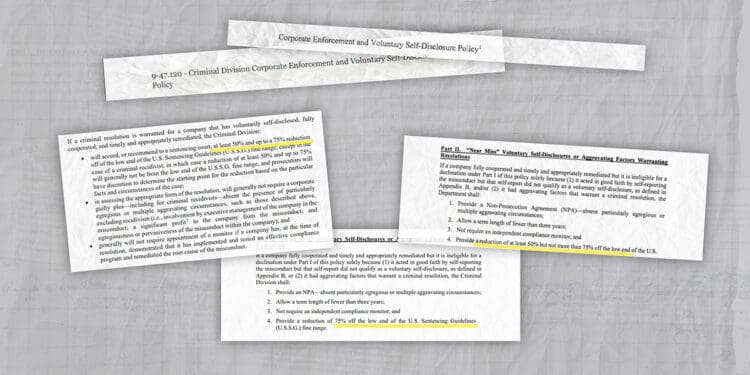
Under Part II, companies that self-reported in good faith but fell short of the full voluntary self-disclosure standard — or that face aggravating circumstances — may receive a nonprosecution agreement (NPA) of fewer than three years, no compliance monitor and a 50%-75% fine reduction.

Under Part III, prosecutors retain discretion over the resolution, with penalty reductions capped at 50%.

The CEP also intersects with the DOJ’s corporate whistleblower awards pilot program: If a whistleblower reports misconduct both internally and to the DOJ, the company can still qualify for a declination but only if it self-reports within 120 days of the internal report. Companies that delay risk losing their window for the most favorable treatment.
corporate enforcement policy wording changes collage
Compliance

One CEP to Rule Them All?

by Jennifer L. Gaskin
March 18, 2026

Read moreDetails

Internal investigations

The Balt SAS resolution illustrates how the CEP works in practice. Balt self-disclosed while its internal investigation was still ongoing, consistent with the CEP’s call to self-disclose “at the earliest possible time, even when a company has not yet completed an internal investigation.” It then cooperated fully, providing all known relevant facts and identifying the individuals involved, and took timely remedial action, including disciplinary measures, termination of the business relationships at issue and improvements to its compliance program. The DOJ found no aggravating circumstances.

The DOJ simultaneously indicted two individuals associated with Balt, reinforcing that leniency for the company does not shield culpable individuals. As Assistant Attorney General A. Tysen Duva put it, the resolution “demonstrates the value of voluntarily self-reporting wrongdoing to the Department of Justice.”

Balt is proof that the CEP rewards speed and cooperation. But for companies to act quickly, the infrastructure must already be in place. Companies need to have compliance plans and procedures in place to respond to concerns, whether raised through hotline complaints, internal reporting, audits or other channels.

When a potential issue surfaces, a prudent company will need to conduct its own investigation with the support of counsel, whether internal or external. The CEP frames this as optional — “if the company chooses to conduct one” — but as a practical matter, an investigation is how a company determines whether and when to self-report, gathers the facts to satisfy the CEP’s cooperation requirements and positions counsel to advocate on its behalf.

Investigations should be structured from the outset to support what the CEP defines as full cooperation. That means proactively disclosing relevant facts, attributing those facts to specific sources rather than offering a general narrative, identifying responsible individuals, providing rolling disclosures as the investigation progresses, preserving documents — including those located overseas — and making employees available for interviews. The CEP’s cooperation standard demands more than passive responsiveness; it rewards companies that get ahead of the government’s questions.

Remediation should not wait for the investigation to conclude, either. Companies should begin remedial measures as the investigation progresses, including but not limited to root-cause analysis, compliance program enhancements and disciplinary action against responsible employees. This demonstration of good faith positions the company for the strongest possible outcome under the CEP.

Self-reporting

Every investigation is different, and the decision to self-report requires careful judgment. But certain findings during an investigation should weigh heavily in favor of disclosure. The most obvious is credible evidence of criminal conduct, particularly bribery, fraud or corruption, that could implicate federal statutes.

The risk of being beaten to the DOJ’s door also matters. With the corporate whistleblower awards pilot program in effect, employees and other insiders have financial incentives to report misconduct directly to the department. Once a whistleblower has already reported internally, the company has at most 120 days to self-report and preserve its eligibility for a declination. Delay can be costly.

When the investigation identifies specific individuals who engaged in wrongdoing, self-reporting positions the company to demonstrate that it is not shielding bad actors, a consideration that clearly mattered in the Balt SAS resolution. Similarly, if there is a realistic possibility that the conduct will surface independently through regulatory audits, media reporting, civil litigation or other means, the CEP’s requirement that disclosure occur before “an imminent threat of disclosure or government investigation” makes early action essential.

Finally, the CEP’s broader Part II reduction range — 505–75% off the low end of the sentencing guidelines fine range — may signal that the DOJ intends to give credit in more situations than prior policies allowed, making self-reporting valuable even in less clear-cut cases. And because the CEP does not displace prosecutors’ traditional discretion under the “Principles of Federal Prosecution of Business Organizations,” internal investigations conducted by counsel also position the company to advocate through those avenues.

Conclusion

The Balt SAS resolution demonstrates what companies stand to gain by investing in compliance infrastructure and treating internal investigations as a strategic function rather than a reactive one. Under the CEP, the incentives for voluntary disclosure are more clearly defined and more consistently applied than ever before. The time to build that capability is now.


Tags: DOJInternal Investigation
Previous Post

Need for Speed: What DOJ’s New Approach to the CEP Means for Internal Investigations

Next Post

What the Enforcement Record Says About ‘Timely’ Disclosure

Bernadette C. Sargeant, Reginald L. Harris and Alexandra P. Stanley

Bernadette C. Sargeant, Reginald L. Harris and Alexandra P. Stanley

Bernadette C. Sargeant is a partner in the Washington, D.C., office of Stinson. She formerly was assistant US attorney in the US Attorney’s Office for the District of Columbia and served as counsel in the Department of Justice office of professional responsibility and the ethics committee of the US House of Representatives.
Reginald L. Harris is a partner in the St. Louis office of Stinson. He spent 17 years as a federal prosecutor, including in the US Attorney's Office for the Eastern District of Missouri. He also served as the white-collar chief and led the office's civil rights program.
Alexandra P. Stanley is an associate in the Minneapolis office of Stinson. She assists individuals and companies with a wide range of investigations, enforcement and litigation matters. She also counsels clients on their internal compliance programs.

Related Posts

data abstract numbers

The DOJ Wants Strong FCA Whistleblower Lawsuits From Data Miners

by Selina P. Coleman, Lesley C. Reynolds, Thomas H. Suddath Jr., David A. Bender and Matthew K. Loughran
May 14, 2026

The FOCUS initiative sets parameters for the DOJ’s support of data miners’ qui tam complaints.

doj timeliness collage

What the Enforcement Record Says About ‘Timely’ Disclosure

by Jennifer L. Gaskin
May 13, 2026

Of the nine enforcement cases CCI examined where companies received credit for timely disclosure, only two included a measurable time...

speeding train in motion

Need for Speed: What DOJ’s New Approach to the CEP Means for Internal Investigations

by Paul Cadwallader
May 12, 2026

Companies will increasingly be judged on whether they could have found problems sooner

gulf coast countries map

FCPA Compliance Programs Are Missing Important Nuances About How Bribery Works in the Persian Gulf

by Majid Mumtaz
April 1, 2026

Applying a Western compliance framework can obscure the tell-tale signs of fraud and corruption in Gulf Cooperation Council markets. Majid...

Next Post
doj timeliness collage

What the Enforcement Record Says About ‘Timely’ Disclosure

No Result
View All Result

Privacy Policy | AI Policy

Founded in 2010, CCI is the web’s premier global independent news source for compliance, ethics, risk and information security. 

Got a news tip? Get in touch. Want a weekly round-up in your inbox? Sign up for free. No subscription fees, no paywalls. 

Follow Us

Browse Topics:

  • CCI Press
  • Compliance
  • Compliance Podcasts
  • Cybersecurity
  • Data Privacy
  • eBooks Published by CCI
  • Ethics
  • FCPA
  • Featured
  • Financial Services
  • Fraud
  • Governance
  • GRC Vendor News
  • HR Compliance
  • Internal Audit
  • Leadership and Career
  • On Demand Webinars
  • Opinion
  • Research
  • Resource Library
  • Risk
  • Uncategorized
  • Videos
  • Webinars
  • Well-Being
  • Whitepapers

© 2026 Corporate Compliance Insights

Welcome to CCI. This site uses cookies. Please click OK to accept. Privacy Policy
Cookie settingsACCEPT
Manage consent

Privacy Overview

This website uses cookies to improve your experience while you navigate through the website. Out of these, the cookies that are categorized as necessary are stored on your browser as they are essential for the working of basic functionalities of the website. We also use third-party cookies that help us analyze and understand how you use this website. These cookies will be stored in your browser only with your consent. You also have the option to opt-out of these cookies. But opting out of some of these cookies may affect your browsing experience.
Necessary
Always Enabled
Necessary cookies are absolutely essential for the website to function properly. These cookies ensure basic functionalities and security features of the website, anonymously.
CookieDurationDescription
cookielawinfo-checbox-analytics11 monthsThis cookie is set by GDPR Cookie Consent plugin. The cookie is used to store the user consent for the cookies in the category "Analytics".
cookielawinfo-checbox-functional11 monthsThe cookie is set by GDPR cookie consent to record the user consent for the cookies in the category "Functional".
cookielawinfo-checbox-others11 monthsThis cookie is set by GDPR Cookie Consent plugin. The cookie is used to store the user consent for the cookies in the category "Other.
cookielawinfo-checkbox-necessary11 monthsThis cookie is set by GDPR Cookie Consent plugin. The cookies is used to store the user consent for the cookies in the category "Necessary".
cookielawinfo-checkbox-performance11 monthsThis cookie is set by GDPR Cookie Consent plugin. The cookie is used to store the user consent for the cookies in the category "Performance".
viewed_cookie_policy11 monthsThe cookie is set by the GDPR Cookie Consent plugin and is used to store whether or not user has consented to the use of cookies. It does not store any personal data.
Functional
Functional cookies help to perform certain functionalities like sharing the content of the website on social media platforms, collect feedbacks, and other third-party features.
Performance
Performance cookies are used to understand and analyze the key performance indexes of the website which helps in delivering a better user experience for the visitors.
Analytics
Analytical cookies are used to understand how visitors interact with the website. These cookies help provide information on metrics the number of visitors, bounce rate, traffic source, etc.
Advertisement
Advertisement cookies are used to provide visitors with relevant ads and marketing campaigns. These cookies track visitors across websites and collect information to provide customized ads.
Others
Other uncategorized cookies are those that are being analyzed and have not been classified into a category as yet.
SAVE & ACCEPT
No Result
View All Result
  • About
    • About CCI
    • Writing for CCI
    • NEW: CCI Press – Book Publishing
    • Advertise With Us
  • Explore Topics
    • See All Articles
    • Compliance
    • Ethics
    • Risk
    • Artificial Intelligence (AI)
    • FCPA
    • Governance
    • Fraud
    • Internal Audit
    • HR Compliance
    • Cybersecurity
    • Data Privacy
    • Financial Services
    • Well-Being at Work
    • Leadership and Career
    • Opinion
  • Vendor News
  • Downloads
    • Download Whitepapers & Reports
    • Download eBooks
  • Books
    • CCI Press
    • New: Bribery Beyond Borders: The Story of the Foreign Corrupt Practices Act by Severin Wirz
    • CCI Press & Compliance Bookshelf
    • The Seven Elements Book Club
  • Podcasts
    • Great Women in Compliance
    • Unless: The Podcast (Hemma Lomax)
  • Research
  • Webinars
  • Events
  • Subscribe

© 2026 Corporate Compliance Insights