A chance discovery of an anthropologist’s book “Bullshit Jobs” got audit executive Anne DeTraglia thinking. Does her profession help out in the grand scheme of things, and is it really all that meaningful if it can be automated by AI? Don’t be scared to ask these questions.
I enjoy reading nonfiction books, typically in the category of business. If you looked upon my shelf, you would find the Heath Brothers, Daniel Pink, Mark Manson, Marshall Goldsmith and yes, Stephen Covey. An author I recently stumbled upon, American anthropologist David Graeber, wrote a book in 2018 titled “Bullshit Jobs.” The title caught my attention, as I am sure the title of this essay caught yours. This book was an extension of an essay he wrote in 2013 in Strike! Magazine, which became wildly popular. (Probably the title, amirite?)
But today, the question of whether a job is “pointless” is no longer just a philosophical debate for anthropologists; It’s an urgent survival manual as AI begins to automate many of the tasks we once used to prove our worth.
Consider the categories of pointless jobs Graeber identified:
- Box tickers: Used to create the appearance of productivity or compliance.
- Flunkies: Exist only to make their superiors feel or look important.
- Goons: Necessary only because other people have them.
- Duct tapers: Hired to fix problems that shouldn’t exist in the first place.
- Taskmasters: Middle managers who create extra work for others.
You’re thinking of which category you belong to right now, aren’t you? I know I did. My profession is in internal audit and risk management. And this is what I found when I dove into the rabbit hole of Graeber’s research and his critics. I stumbled upon this gem from a chap named “The Jolly Contrarian,” excerpted in the below image:
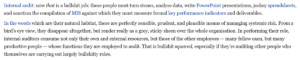
(Oh, Jolly One, them’s fightin’ words. That said, I will admit that I did laugh and promptly emailed a link to that article to most of my internal audit friends.)
This concept of a job being “bullshit” is based on a theory that society would be no worse off (or even notice) if such a job disappeared. Ostensibly, people working in these types of jobs do not believe their role contributes meaningfully to the world, and they do not personally find their job fulfilling.
For the record, I do not hold those feelings. On most days, I do find my work to be fulfilling and contributing to the benefit of the world. However, we would be foolish not to consider what the future of our chosen professions will look like in this new world of AI. How does our work contribute to the world and is it truly meaningful if most of it can be automated away? And does that imply that it was all bullshit anyway?
What are humans for?
I recently had the privilege of hearing Richard Susskind, who is, among other things, a renowned author and the IT adviser to the Lord Chief Justice of England and Wales, speak on the topic of AI and the future of work. He spoke at length about the importance of how we deliver our expertise and to consider the fundamental value your profession brings to the world in the age of AI.
Susskind challenged me and others in the audience to answer this question: How in the future will businesses solve problems for which your professions are the answer? We know what that looks like today. With AI, what will it look like in three years? What about in 10 years? You cannot answer that question without seriously considering the fundamental value your profession brings to bear. He asked, “Can you boil it down to its essence?” In other words, are there other ways to bring it to bear?
How often do we pause and truly consider these philosophical questions? Now is the time to do so.
He gave an example for the audience to ponder. Consider neurosurgeons today. The future, with AI, may include fewer invasive therapies like surgery. We won’t place the ambulance at the bottom of the cliff, but rather we will place a fence at the top of the cliff. AI will give a patient far more information in advance to avoid surgery altogether. So, what will be the need for a neurosurgeon? The broader question we all need to ponder is what is the inherent value we bring to the world as a human in our profession that AI cannot replace?
If we evaluate the use of AI today in most professions, it is largely centered on gaining efficiencies through automation. That’s not necessarily a bad thing. But are we, paradoxically, proving out the bullshit in our jobs?
The World Economic Forum recently published a report noting that accountants and auditors, along with business service and administrative managers (all bullshit jobs, according to Graeber) will have decreased job demand between 2025 and 2030. The No 1 technology trend driving this change? AI and information processing technologies, followed closely by robots and autonomous systems. Automation is coming for me, apparently. But if the machines take over the processing, who is left to do the thinking?
(This Is a Lie) AI Is Inevitable
The only thing truly inevitable about AI is we can’t stop talking about it
Read moreDetailsFacts need a human filter
Internal auditors must be independent and objective truth tellers. Ideally, we say what needs to be said when the organization is at risk. Presumably, AI could be more independent and objective than any human could be with the same set of facts. It would not be constrained by emotions and office politicking. The AI auditor, all things being equal, could present the cold, hard facts, and management would be able to act upon them.
So, the question becomes if an internal auditor, or any compliance professional, for that matter, has most of their work fully automated, then what is really left for them to do? What value are they adding to the organization?
As a leader, I have often summarized a professional career pathway this way: You begin your journey as an individual who is assigned tasks that you execute under someone else’s direction and guidance. Later, you learn how to assign tasks to others. After that, you learn how to develop and lead others as individuals until ultimately, you learn how to do that with teams.
In the beginning, you need only basic knowledge and skills. Over time, you develop abilities — things like self-awareness, creative thinking and negotiation skills. Unfortunately, abilities cannot always be taught; some are only learned over time through keen observation and learning agility. You also need to be willing to make mistakes and ask, receive and act upon feedback.
Seems easy. It is not. Can AI do that? No. Not yet at least.
What happens when the cold, hard facts arrive and there isn’t any analytical thinking behind them? Imagine your AI auditor in a biotech research company delivers a report that recommends immediate termination of a vaccine project to prevent insolvency because the firm spent millions on a specific chemical compound that resulted in no saleable product and 90% of the staff hours were spent on “zero market-ready” solutions. Of course, the reality of biotech R&D is that a 95% failure rate is normal. This is the scientific process at work. The labor hours weren’t wasted at all. Those PhDs were documenting why the trial didn’t work, intellectual property that is vital for the organization’s future patents.
One could see this AI auditor becoming ignored over time and losing value. As I have often said to my team: Do you want to be right or do you want to get it right?
Perhaps that is what Susskind meant when he spoke of finding the essence of what you do. What is the humanity in your work? How can we highlight that humanity? Does it start when we identify the moment when a spreadsheet simply isn’t enough? Is it that moment when a human begins to deploy their curiosity, empathy or their senses and gut instincts?
The human in the loop
I don’t have all the answers to these deeply personal and philosophical questions of how each of us adds our humanity to our chosen profession. I am just starting to consider them myself. I have four children in their 20s who are entering a workforce that is rapidly changing.
The World Economic Forum notes 26 core human skills in 2025 to develop, presumably to augment our skills in this world of AI. These are five of the top eight and some prompts I’ve noted to get us thinking. What would you add? What is the essence of what you do?
1. Resilience, flexibility and agility
- What part of your work involves channeling strengths like dealing with difficult people?
- When you work with someone who cannot seem to get anything done and their lack of progress impedes your project, do you know how to sit with them, channel your curiosity, state the facts and pose a solution that invites them into the conversation?
2. Curiosity and lifelong learning
- Can you think of a time when your role caused you to make a difficult decision based on your ethics and values rather than data or what would’ve been an easy choice?
- If you observed a pattern of spending, based on your experience alone, that isn’t technically a violation of policy but appears to be unusual and realized it was fraud involving a senior executive, would you be able to resolve that?
3. Empathy and active listening
- As a leader (and we are all leaders), can you recall a time when you “read the room” and spoke up because it was the right thing to do for a human being?
- Could you speak up when you observe a colleague taking credit for something another colleague previously said in a meeting?
- What part of your work involves understanding what is said and how it is said?
- When a seemingly innocuous issue is being discussed and a colleague is defensive and raising their voice or changing their story when it isn’t called for, can you draw conclusions from that which might help you understand what’s happening?
4. Leadership and social influence
- How much of your legacy comes from inspiring others? Building a culture of belonging?
- Are you able to create an environment for team members that celebrate their unique background and contributions, such as Eid, Lunar New Year, Fika and Diwali?
5. Analytical thinking
- How often do you synthesize results from different areas to tell one holistic story that tells the bigger picture?
- Can you take disparate information and determine the root cause which may be a systemic cultural failure that needs to be addressed rather than one rooted in data alone?
I think “Bullshit Jobs” is fundamentally correct in terms of its humanity. People should feel their work matters to themselves and society. Does all work feel that way all of the time? Of course not. That doesn’t mean it’s bullshit.
Humans need people like me and other compliance professionals. You know why? Because humans get into bullshit (e.g., corruption, stealing, lying, behaving badly) when there are no rules. Look at history. Box-ticker compliance professionals aren’t going to save everyone, but our humanity is the secret sauce we bring to stopping the bullshit and advocating for the good shit.

 Anne DeTraglia is a chief audit executive, certified internal auditor and certified fraud examiner. She has held senior leadership roles at The Home Depot, Sears Holdings, United Airlines, Nike, Whole Foods Market, Harman (Samsung) and Sabre Corp. She is a frequent speaker for the Institute of Internal Auditors, The Association of Certified Fraud Examiners, The Institute of Management Accountants and The Internal Audit Collective.