
Organizations struggle to create meaningful incentives for ethical behavior beyond the fear of punishment. Law student Aram Sahakyan maps out how virtue ethics — the ancient Greek philosophy of character development — offers compliance programs a powerful tool for shifting focus from rules and consequences to the cultivation of virtuous traits, practical wisdom and moral exemplars who embody the “golden mean” between ethical extremes.
Merely because you can do something, that does not necessarily mean that you should do it. In the compliance industry, but also in life, determining whether one should do something is often an ambiguous task without a clear-cut answer. That makes ethics an integral component of compliance practice.
Individuals conduct their analysis on whether they should do something using a variety of ethical sources. In organizational compliance, the sources are typically the organization’s code of conduct, the employee handbook and/or formal compliance training.
However, there are other ethical sources for compliance practitioners and colleagues to rely on that date back thousands of years.
One such source is an ancient Greek philosophy called “virtue ethics.” Initially attributed to thinkers like Plato and Aristotle, the teachings of virtue ethics are extremely well-suited to compliance programs and training for organizations of all kinds.
Virtue ethics is not tied to a particular religion, which makes it an attractive source to draw from that will resonate with individuals from different backgrounds. In its simplest form, virtue ethics emphasizes the importance of developing and cultivating virtuous character traits and dispositions. These traits include courage, justice, wisdom and honesty.
The ‘golden mean’
A critical point about cultivating virtuous traits is that the moral agent must find what Aristotle called the “golden mean,” or the middle ground between two extremes. The virtue of courage, for example, is finding a balance between cowardice and recklessness.
Virtue ethics takes an approach to morality that focuses on the character of the moral agent, rather than on formal rules or consequences of the agent’s actions, defining moral actions as those that embody virtuous character traits, while immoral actions display vices.
The goal is not simply to follow rules but to become a person of good moral character through practice and habit. In order to assess an agent’s moral character, virtue ethics emphasizes practical wisdom, which requires context-sensitive judgment and considering the moral agent as a whole, rather than assessing an isolated incident as such. The promise of virtue ethics is that by constantly cultivating and developing virtues, an individual may lead a life of happiness and fulfillment.
Finally, virtue ethics encourages the use of moral role models as exemplars of virtuous behavior. As a result, the question “What should I do?” becomes “What kind of person should I be?” under a virtue ethics framework.
In organizational terms, then, implementation of virtue ethics forces a focus on tone from the top. An organization’s leaders must be role models for those they lead. If an organization is truly committed to the tenets of virtue ethics, this will guarantee that virtuous behavior is, first and foremost, exhibited by its leaders.
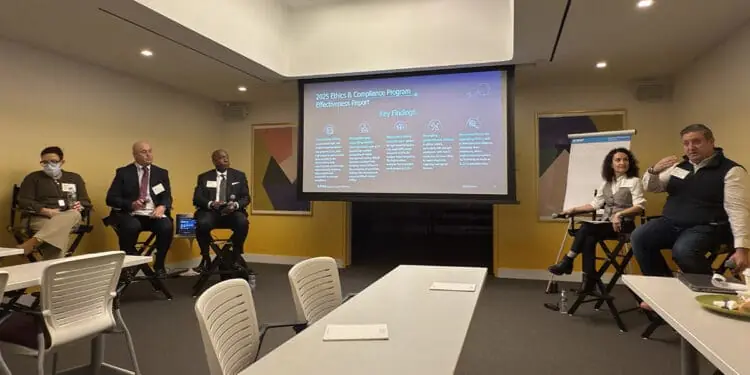
When Ethics Meet Reality: Inside a Frank Discussion on Compliance’s Future
LRN data reveals troubling trust gaps as compliance leaders wrestle with program effectiveness in a hybrid world
Read moreDetailsVirtue ethics & compliance
In compliance practice, determining incentives for compliance and disincentives for noncompliance can be tricky. Many of us are taught that there are rewards for good behavior and punishments for bad behavior.
Since most rewards and punishments come from external sources, they do not always effectively motivate individuals to act in compliant or ethical ways. Virtue ethics can provide incentives and disincentives that are purely internal.
Instead of practicing compliance and ethical behavior to avoid punishment from superiors or government officials, virtue ethics induces individuals and organizations to act in such a manner for the betterment of themselves. If an organization adopts a culture based on virtue ethics, conducting one’s self ethically becomes an issue of their very existence. If one wants to lead a fulfilling life, beyond merely keeping their job, virtue ethics is a critical pillar to rely on.
Another area in compliance where virtue ethics can play a pivotal role is in enforcement and discipline. Since virtue ethics emphasizes practical wisdom, compliance professionals tasked with disciplining infractions have a robust lens to assess a particular infraction and determine what discipline, if any, is appropriate. When an infraction occurs, the disciplining authority may consider the whole person in their compliance efforts, including motivations, emotions and character, rather than focusing solely on an isolated action.
In this way, compliance enforcement and discipline can go beyond punishing bad behavior to actually identifying the root cause of an infraction and what can be done to prevent it in the future.

 Aram Sahakyan is a 2025 J.D. candidate at George Mason University's Antonin Scalia Law School. He is an alumnus of Colorado State University, where he earned his bachelor's degree in philosophy and completed externships and internships at Meta Law, Odin Feldman Pittleman and the Montgomery County (Md.) Department of Housing and Community Affairs.