
The practical implication of new welding fume designations and limitations in California and internationally is less about adding another checklist task and more about where compliance sits organizationally, explains Neeta Verma, an environmental compliance professional. For compliance teams, if you’re just looking into a bill of materials, you’re running on fumes.
In July, California’s Office of Environmental Health Hazard Assessment (OEHHA) added welding fumes, along with three prescription pharmaceuticals, to the Proposition 65 list of chemicals known to cause cancer.
For compliance leaders, the welding-fumes listing is the more consequential kind of addition. It does not simply add another chemical to check against a bill of materials. It adds a process-generated exposure that can change as manufacturing and field activities change, pushing compliance from periodic product review toward continuous coordination with engineering and environmental health and safety (EHS).
Most product compliance programs, Proposition 65 included, run on a periodic model: pull the bill of materials, check it against a chemical list, collect supplier declarations, sign off and revisit at the next product change or list update. That works when the chemical is an ingredient that can be tested for, documented or engineered out.
Welding fumes cannot be managed that way because they are not an ingredient. The OEHHA listed them through Proposition 65’s Labor Code mechanism, following a study published by the International Agency for Research on Cancer. Exposure is generated by welding and related activities wherever they occur, often outside a compliance team’s normal line of sight.
A one-time review of what is in a product says nothing about whether those activities are creating an exposure.
The bill of materials blind spot
A product can remain unchanged on paper while the exposure scenario around it changes. Production can move to a facility with different welding processes. A supplier could subcontract fabrication without changing its material declaration. Engineering may introduce new welding techniques or a field-service team might weld when that wasn’t in the plan. None of those changes necessarily appears in a bill of materials because the risk was never encoded there.
Further, even in situations where circumstances have not changed, the information often instead sits across the organization. Engineering understands manufacturing and repair processes. EHS holds exposure-monitoring and control information. Product stewardship sees the product across its lifecycle. Supply chain knows where fabrication and service work is outsourced.
That is particularly important because the OEHHA has not yet established a level of “no significant risk” for welding fumes. Organizations can’t simply anchor their assessment to an OEHHA safe-harbor number and may need to make exposure judgments based on operational facts.
From gatekeeper to governance integrator
Engineering change management typically involves looking into whether modification affects specifications, cost, quality or material composition. For a process-generated risk, it also needs to involve examining if this change creates or materially alters an exposure scenario. If it does, that information needs a defined route to compliance rather than leaving compliance to discover it later.
Supplier governance faces the same problem. A material declaration identifies substances in supplied materials but may say little about fabrication or finishing processes capable of generating exposure. With subcontracted production, that information can be several tiers away from where compliance normally looks.
Field activity creates another blind spot. Installation, maintenance and warranty repair can generate exposures years after a product leaves the factory with the relevant information sitting in service-management or EHS systems that a product-compliance database was never designed to see.
Compliance teams shouldn’t create another checklist to respond to these issues, but stronger information architecture. Process changes that can alter exposure should trigger regulatory review. Relevant EHS assessments should feed compliance decisions. Supplier and service governance should provide visibility into outsourced activities that create exposure.
None of this means compliance has to take control of engineering or industrial processes. Rather, compliance needs a governance channel that allows those functions’ knowledge to reach a regulatory decision before an outside party exposes the gap.
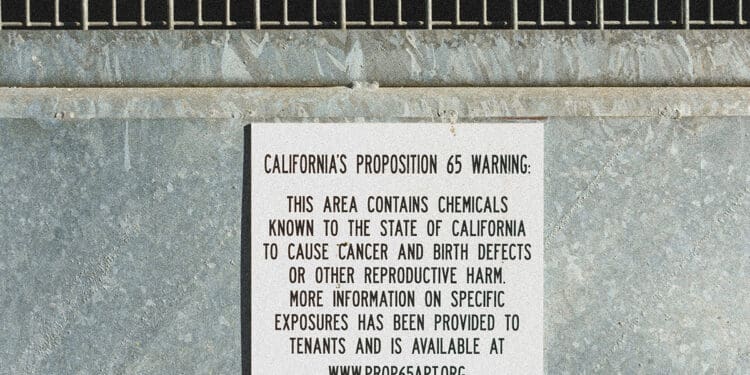
Changes Coming to California Prop. 65 Warnings
The law might suggest warnings are required in limited situations, but that’s not how it plays out
Read moreDetailsA structural signal
The international outlook suggests this is not simply a California issue.
In the European Union, the European Parliament and Council reached a provisional political agreement in June on the sixth revision of the Carcinogens, Mutagens and Reprotoxic Substances Directive. The agreement brings welding fumes within the directive’s scope and directs the European Commission to assess whether additional exposure limits are needed for substances contained in welding fumes. Formal adoption is pending.
Australia has been tightening on a similar timeline. Its workplace exposure standard for welding fumes was reduced by 80% in 2024. The workplace exposure standard for aluminium welding fumes was also reduced in 2025. In December, Australia will transition from workplace exposure standards to workplace exposure limits with revised limits affecting a range of airborne contaminants.
For multinational compliance functions, these differences reinforce the same lesson: Chemical risk cannot always be understood through product composition alone. Organizations also need visibility into the processes that create exposure.
Where we’re headed
Without a standing mechanism for feeding relevant changes into compliance, information can remain invisible until an audit, customer inquiry or enforcement action. Proposition 65’s private-enforcement structure makes that an especially expensive way to discover it.
The answer is not a task force created ahead of the 2027 warning deadline and dissolved afterward. It is a durable channel between compliance and the functions that generate and understand exposure, independent of whether any individual product ultimately requires a warning.
The broader lesson is that compliance can no longer be managed from the bill of materials alone. For process-generated risks, it must also work from real-world operations back into the compliance system.

 Neeta Verma is an environmental compliance and enterprise quality governance leader with 27-plus years of experience in the global electronics industry, specializing in product environmental compliance and regulatory strategy. She has extensive expertise in global environmental regulations, hazardous materials governance, supplier compliance and regulatory intelligence.