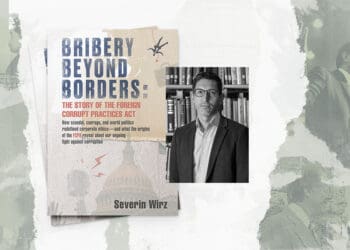
The debut book by legal historian Severin Wirz, “Bribery Beyond Borders: The Story of the Foreign Corrupt Practices Act,” is a timely reexamination of the landmark anti-corruption statute’s Cold War origins and modern-day relevance. Published by CCI Press, Wirz’s book arrives as the FCPA nears its 50th anniversary and faces renewed scrutiny from reformers, regulators and multinational corporations alike.
Told through the lens of human tragedies, dogged determination and political intrigue, Wirz’s book weaves together discrete threads in the years leading up to the passage of the Foreign Corrupt Practices Act, culminating in its final signing by President Jimmy Carter in 1977.
Below, an excerpt from “Bribery Beyond Borders” tells us what happened next.
The FCPA: From Dormant Law to Global Blueprint
In the years immediately following its passage, the FCPA seemed destined to languish in the annals of criminal law. The Reagan administration rarely enforced the statute, while outside the United States, proponents of a multilateral anticorruption treaty were met with fierce opposition.1 “A bunch of pip-squeak moralists running around trying to apply U.S. puritanical standards to other countries,” one businessman and early FCPA critic complained.2 As the U.S. trade deficit peaked in the mid-1980s and the U.S. dollar sharply appreciated during that same period, there were mounting calls in Congress to amend the statute.3 In the summer of 1988, the Reagan administration eventually succeeded in passing new corporate-friendly amendments to the FCPA as part of the Omnibus Trade and Competitiveness Act—both broadening the definition of so-called “facilitating payments” and increasing the degree of knowledge required to hold U.S. businesses accountable for bribes paid by third-party agents.4
But then, as is wont to happen, the world changed again. The fall of the Berlin Wall in 1989 and the subsequent dissolution of the Soviet Union a few years later marked an important turning point in the history of anticorruption. Seemingly overnight, hopes for a new political order swept over Eastern Europe and Central Asia, with lawyers and political experts from the West enthusiastically engaging now formerly communist countries to provide technical assistance to implement democratic reforms.5 The demise of the Soviet Union meant the ideological triumph of capitalism and the widespread acceptance of principles of free trade and globalization. Among both Democrats and Republicans, Milton Friedman’s brand of neoliberalism influenced a broad post-Cold War consensus known as the “Washington Consensus.” Accordingly, the proper role of governments and institutions became to assist in ordering the global economic marketplace. The fight against corruption, which was viewed as a threat to these open and orderly markets, was a key component of this new paradigm shift and fit neatly within the rhetoric of “structural adjustments” and “good governance” that became popular at the time.6
By the mid-1990s, then, focus on anticorruption had firmly become part of the overall strategy of the United States to promote economic globalization and geopolitical stability. Yet the United States government still faced the problem that among Western allies, it alone banned foreign corruption. While perhaps frowned upon at diplomatic cocktail parties, paying bribes to win business abroad was still commonplace among many European countries, including in Germany and France, where companies were even allowed to write off overseas bribes as tax deductions. To address this gap, the Clinton administration soon sought to standardize the FCPA in other parts of the world. Secretary of State Warren Christopher and Assistant Secretary of State Dan Tarullo began in 1994 by targeting the Paris-based Organization for Economic Co-operation and Development (OECD), an exclusive assembly of the world’s largest trading partners. Those efforts coincided with a burgeoning anticorruption movement already taking shape in Europe, where human rights activists and development experts began campaigning against corruption as a political and economic imperative to address the needs of developing countries.
Two years later, in October 1996, World Bank President James Wolfensohn would directly link global investments to good governance and accountability in what would later be hailed as a “watershed” moment by anticorruption advocates. “Let’s not mince words,” Wolfensohn declared in a speech before the Bank’s board of governors, “we need to deal with the cancer of corruption.”7 Until then, the Bank had assiduously avoided the topic—so much so that just a few years earlier, a program manager at the Bank, Peter Eigen, quit to found the nonprofit Transparency International (TI) after witnessing firsthand several Bank-funded projects in Kenya waste away due to corruption.8 Wolfensohn’s “cancer of corruption” speech addressed the issue head-on, eliminating any remaining taboo surrounding the topic in economic development circles and formally integrating integrity and governance reform into the formal programming of large, intergovernmental institutions.
Around the same time, U.S. lobbying efforts in the international arena equally began to pay off. In March 1996, the Organization of American States (OAS) passed the Inter-American Convention Against Corruption, the first-ever multilateral treaty on the issue. Then, the following year, in November 1997, the OECD’s twenty-nine member countries signed the landmark Convention on Combating Bribery of Foreign Public Officials in International Business Transactions, often referred to in anticorruption circles simply as “the OECD Convention.”9
It was an exciting time, as the anticorruption movement seemed to finally be taking off. Awareness-raising by the World Bank, the OECD, TI, and other nonprofits caught the attention of the global media, with coverage of anticorruption efforts appearing regularly in the New York Times, the Financial Times, and the Guardian. In addition to Peter Eigen, other important figures to emerge included Mark Pieth, Chair of the OECD Working Group on Bribery. It was not long before the G20, the UN Office on Drugs and Crimes, and other global organizations soon joined in what was being called “the global fight against corruption.”
The crown jewel at the center of these efforts was the OECD Convention. Not only did the treaty bring together the largest assembly of global trading partners, but it also accomplished two related aims. First were its economic goals, as the United States made clear in a statement released upon ratifying the Convention by tying implementation directly to “the promotion of stronger, more reliable, and transparent foreign legal regimes that, in turn, make for more reliable and attractive investment climates.”10 The view was that tackling corruption and promoting globalization were one and the same. Second, the OECD Convention successfully internationalized the FCPA, providing the U.S. government a mechanism through which it could at long last ensure a single set of standards. Borrowing almost word for word from the language of the FCPA, the Convention required signatory countries to both criminalize bribery of foreign public officials and require their companies to keep accurate books and records.11 Soon, other intergovernmental organizations, including the Council of Europe, the African Union, and the United Nations, would enact similar multilateral anticorruption treaties—each one incorporating the FCPA’s two primary provisions almost whole cloth.12
The importance of the FCPA in the modern anticorruption era is, therefore, difficult to overstate. Unlike most domestic laws with international application, the FCPA has become a kind of international law unto itself, effectively serving as the blueprint for an entire international legal framework. As NYU law professor Kevin Davis notes, “since the enactment of the FCPA, U.S. transnational bribery law has grown from an idiosyncratic but weakly enforced branch of U.S. law into the lynchpin of a prominent and potent global regime.”13
FOOTNOTES
1. Data for DOJ and SEC Enforcement Actions per Year, Foreign Corrupt Practices Act Clearinghouse, Stanford Law School; see also Wesley A. Cragg and William Woof, “The US Foreign Corrupt Practices Act and its implications for the Control of Corruption in Political Life,” Business and Society Review, 107:1 (Dec. 17 2002), 17 (noting that following the inauguration of President Reagan, enforcement patterns changed and enforcement of the FCPA was relaxed, funding for the two principal enforcement agencies was considerably reduced, and efforts by the administration to alter the provisions of the Act were initiated).
2. Thomas Gladwin and Ingo Walter, “The Shadowy Underside of International Trade,” Saturday Review, July 9, 1977, 22, quoting Charles Bowen, former chairman of Booz Allen and Hamilton, a leading management consulting firm.
3. S. 2763, A bill to amend and clarify the Foreign Corrupt Practices Act of 1977, (1980); S. 708, A bill to amend and clarify the Foreign Corrupt Practices Act of 1977, (1981), S. 414, A bill to amend and clarify the Foreign Corrupt Practices Act of 1977, (1983), S. 430, A bill to amend and clarify the Foreign Corrupt Practices Act of 1977, (1985).
4. Foreign Corrupt Practices Act Amendments of 1988, H.R. 4848, Pub. L. No. 100-418, 102 Stat. 1107, 100th Cong. (1988) (enacted August 23, 1988).
5. The American Bar Association, for example, founded the Central and East European Law Initiative (CEELI) in 1990. Through CEELI, scores of American lawyers and judges traveled to the former Soviet bloc to assist in drafting new laws, as well as running workshops focused on Western-style legal education and judicial development. Notably, many of these ABA efforts were spearheaded by key holdovers from the Carter administration, including Lloyd Cutler, Carter’s former White House counsel, and Homer Moyer, who worked in the general counsel’s office of the U.S. Department of Commerce in the 1970s. Both became leading anticorruption experts in the later parts of their careers. M. M. McKeown, “The ABA Rule of Law Initiative Celebrating 25 Years of Global Initiatives,” Michigan Journal of International Law 39, no. 1 (2018): 117, 121.
6. Michael Johnston and Scott Fritzen, The Conundrum of Corruption: Reform for Social Justice (Routledge, 2021), 127.
7. James D. Wolfensohn, “People and Development: Annual Meetings Address by James D. Wolfensohn, President (English)” (speech, Annual Meetings of the World Bank and the International Monetary Fund, Washington, D.C., October 1, 1996).
8. Kirsten Lundberg, “High Road or Low? Transparency International and the Corruption Perception Index (Case Number 1658),” Harvard Kennedy School (Aug. 1, 2002).
9. OECD Convention on Combatting Bribery of Foreign Public Officials in International Business Transactions, 37 I.L.M. 1 (1998).
10. House Report No. 105-802 Oct. 8, 1998—International Anti-Bribery and Fair Competition Act of 1998.
11. Note that the OECD Convention recognizes that in some countries, (mainly in civil law countries), criminal sanctions may not apply to corporations. In those situations, the Convention requires those countries to impose appropriate monetary sanctions and other penalties.
12. Council of Europe, Criminal Law Convention on Corruption, Jan. 27, 1999, Eur. T.S. No. 173; African Union Convention on Preventing and Combatting Corruption, July 11, 2003, 43. I.L.M. 5; United Nations Convention against Corruption, Oct. 31, 2003, 2349 U.N.T.S. 41.
13. Davis, Between Impunity and Imperialism, 41.